AI adoption strategy for engineering teams: from shadow AI to structured control

TL;DR
Engineering teams at most organizations are already using AI, without formal oversight. This creates shadow AI: ungoverned tool usage that accumulates security debt and compliance risk faster than leadership realizes.
This article gives CTOs and engineering leaders a three-part framework: adoption diagnosis, knowledge governance, and operational ownership to move from fragmented AI use to structured, measurable AI adoption governance.
The debate about whether engineering teams will adopt AI tooling is over. In every organization we work with, the answer is the same: they already have. A meaningful share of new code being written today is AI-written.
Engineers are integrating AI into their daily workflow. Not as experiments, but as standard practice. That shift is real, accelerating, and has outpaced most organizations’ ability to manage it.
So, what is actually happening inside that adoption? And what leaders should do about it? The picture is far more uneven than most leadership teams realize. Controlling AI adoption means moving beyond ad-hoc experimentation toward structured governance that balances innovation with security and compliance.
What is Shadow AI?
Shadow AI is AI tool usage that occurs inside an organisation without formal approval, security review, or output oversight. It’s typically driven by individual productivity gains.
Shadow AI is not malicious; it is the natural result of capable people solving problems with available tools. But it accumulates technical debt and compliance risk that no one is tracking.
Three types of AI adopters in engineering teams
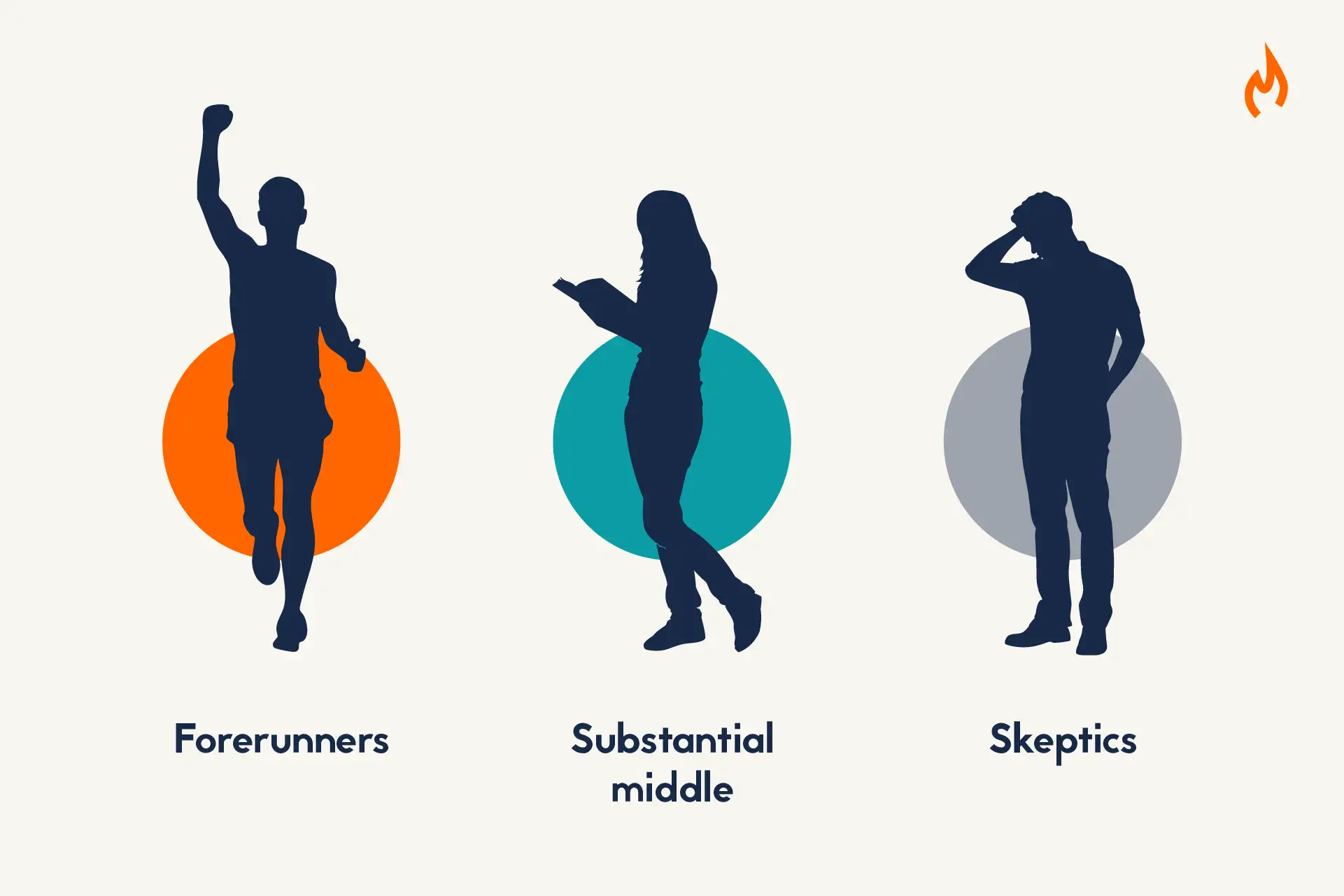
In every software team we look at closely, we see the same pattern: a small group of forerunners, a large middle adopting inconsistently, and a shrinking group of skeptics.
Understanding which group each engineer belongs to is the first step in building effective AI adoption governance.
|
Tier |
Characteristics |
What this group needs from |
|---|---|---|
|
Forerunners |
Have rebuilt significant parts of their |
Surface and amplify. Structured |
|
Substantial |
Largest and most consequential |
Shared standards, a peer to learn from, and clear examples of what good AIassisted work looks like. This group moves fast with the right conditions. |
|
Skeptics |
Diminishing on their own. The cause |
Do not spend disproportionate leadership energy here. Results from the forerunner and middle groups will do more than any mandate. |
“The forerunners in your organization are your most underused asset. The highest-return move available to most leadership teams right now is to deliberately surface what those people know and build the conditions for it to spread.”
That means structured, accountable knowledge transfer, not optional lunch-and-learns. The goal is to reach the middle of the organization systematically.
Why AI knowledge silos form, and how to break them
Because most organizations have no shared engineering practices, each engineer solves the same problems alone.
This is a slow and expensive way to build capability. It also means the organization’s collective learning is entirely dependent on individual memory and goodwill. Neither of them scales, and neither of them survives when someone leaves your company.

Without a formal structure for capturing and distributing AI knowledge, shadow AI thrives. Every engineer develops private workarounds; security risks accumulate undetected; and the gap between your forerunners and your middle widens instead of narrowing.
Shared practice does not emerge organically at this pace of change. It has to be designed. That means creating a centralized repository where working patterns, tested approaches, and hard-won lessons are captured and maintained. And not to forget: assigning someone whose job it is to keep
that resource alive and relevant.
A well-structured AI knowledge base should capture:
- Which tasks benefit most from AI assistance
- Which prompts produce reliable, reviewable results
- Which approaches have failed and why
- Which AI tools are approved versus in shadow use
The goal is not perfection but continuous improvement through shared learning. Organizations that solve this early compound the advantage; those that do not pay a growing knowledge-debt tax.
Building AI governance into your CI/CD pipeline — not your guidelines
As the share of AI-generated work grows, the question of who is responsible for its quality and security becomes increasingly concrete. In most teams today, the guardrails are informal: guidelines, norms, good intentions. That is a soft form of governance that degrades under pressure.
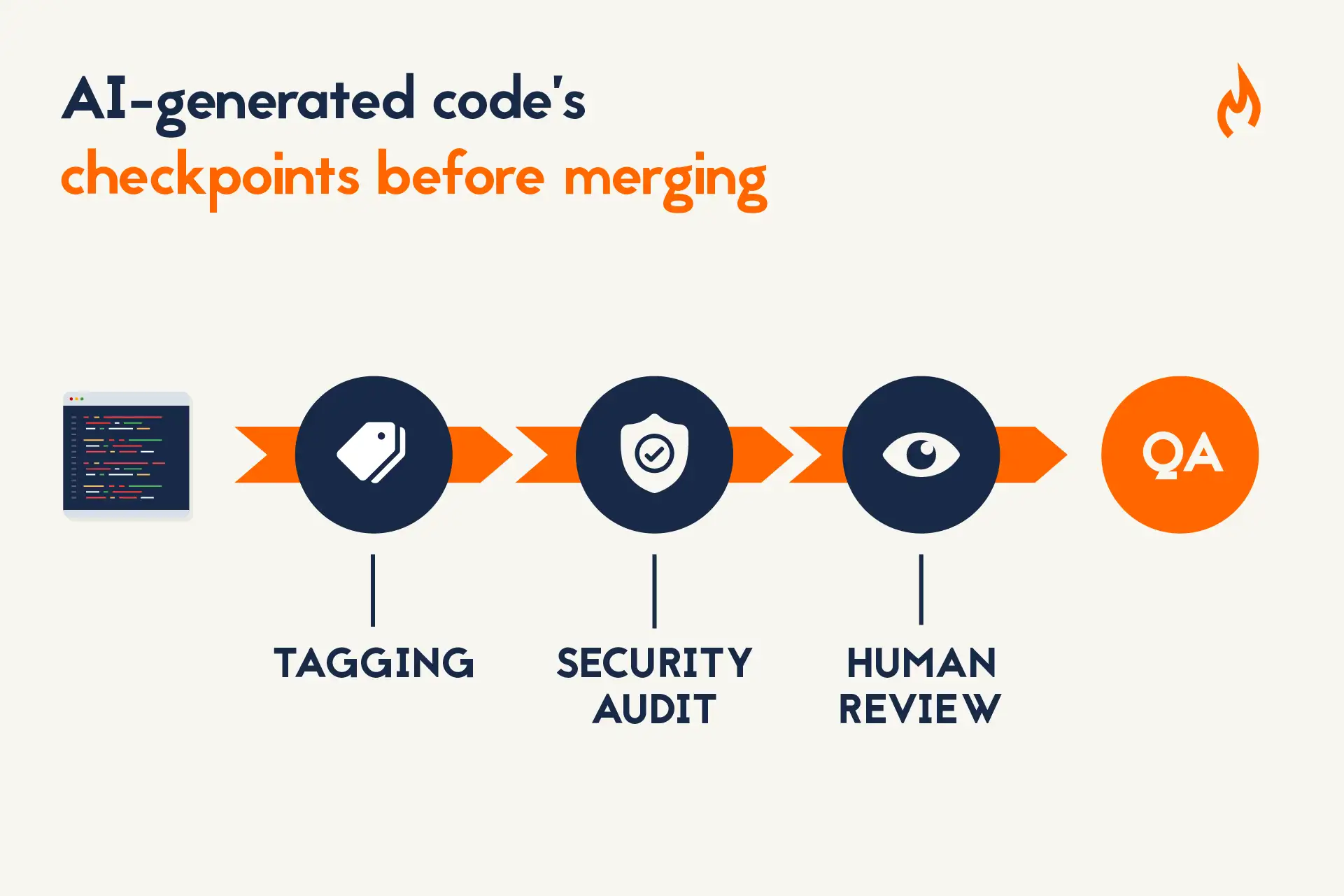
Real AI adoption governance means building quality and security checks into how work moves through the organization, making the right thing the natural path, independent of which engineer is doing the work or how much deadline pressure they are under.
|
Guidelines (soft governance) |
Controls (hard governance) |
|
“Please review AI-generated code carefully.” |
CI pipeline flags AI-generated sections for mandatory human sign-off before merge |
|
“Avoid putting sensitive data into AI prompts.” |
Automated data-classification scanner blocks prompts containing PII or credentials |
|
“Check AI suggestions for security vulnerabilities.” |
SAST and dependency scanning run automatically on every AI-assisted pull request |
|
“Use approved AI tools only.” |
Tool allowlist enforced at the network level; shadow AI tools trigger an access alert |
Effective governance controls are not added as manual checkpoints that slow development. They are embedded in the toolchain so that compliance is the path of least resistance. Engineers do not need to remember a policy. The pipeline enforces it automatically.
Shadow AI warning signs to watch for
Before formal controls are in place, monitor for these signals that ungoverned AI use is accumulating risk:
- Code commits with unusual stylistic consistency – a sign of unreviewed AI output pasted verbatim
- Spike in closed tickets with unusually short cycle times and no associated test coverage
- Engineers referencing tools not on the approved list in PR comments or Slack
- Sensitive data (customer IDs, API keys) appearing in commit history at a higher frequency
- Increased rate of reverted commits or post-merge hotfixes
Appoint an AI transformation lead — with a real mandate
Beneath all of this is a question most organizations are avoiding: Who owns this?
AI transformation follows the same logic as any other significant operational change, as evidenced by research on Sustainable AI Transformation: a critical framework for organizational resilience and long-term viability.

AI transformation follows the same logic as any other significant operational change. It does not happen because leadership decided it should, and it does not happen reliably because individuals are pushing it in their spare time.
It happens when there is committed ownership at the operational level, a lesson well-documented in research on sustainable AI transformation.
Without that, the two most common failure modes are mirror images of each other:
Failure mode 1 — Adoption stays a leadership conversation: Well-intentioned, strategically correct, and almost entirely disconnected from what people actually do on Monday morning.
Failure mode 2 — Adoption is real and growing but completely ungoverned: Enthusiastic, fragmented, and accumulating shadow AI risk that no one is tracking.
Both look like progress. Neither is transformation.
Appoint someone whose job actually involves driving this change. Not as a side responsibility, but as a primary one. The title matters less than the clarity of the mandate and the seniority to act on it.
This person should:
- Report directly to the CTO or VP of Engineering
- Have budget authority for tools, training, and process improvements
- Be accountable for closing knowledge gaps between teams and establishing shared practices
- Be measured on concrete, observable metrics, not cultural sentiment
Suggested metrics for the AI transformation lead:
|
Metric |
Why it matters |
|---|---|
|
% of engineers actively using approved AI tools |
Reveals adoption spread across the middle group |
|
Reduction in time-to-completion for common task types |
Quantifies productivity gain attributable to AI use |
|
Number of security incidents linked to AI-generated code |
Tracks whether governance controls are working |
|
Shadow AI tool detections per quarter |
Measures compliance with the approved tool list |
How to start: 3 questions every CTO should answer this week
If you are a CTO or engineering leader reading this, the place to begin is not a strategy document. It is three concrete questions about your organization right now.
Question 1: Who are your forerunners, and what have they learned?
If you cannot name them and describe what they know, that is the first thing to fix. Schedule one-on-one conversations with your most productive engineers. Ask directly: how are you using AI, what has worked, what has not, and what would help you do more?
Look for engineers who consistently ship faster without sacrificing quality, who volunteer to tackle complex problems, and who others turn to for technical advice.
Review your Git analytics: who is committing more frequently with fewer revisions? Who is closing tickets faster than their historical average? Most forerunners are happy to share what they have learned. They just need to be asked.
Question 2: Where do your AI standards actually live?
If the honest answer is “in a document somewhere”, your governance is softer than you think. Real standards are embedded in tools, enforced by automation, and visible in every pull request. They are not aspirational. They are operational. Ask your team: Can an engineer violate our AI usage policy without anyone noticing? If the answer is yes, your governance exists only on paper.
Question 3: Who owns AI adoption at the operational level?
If the answer is “everyone” or “the engineering leads, broadly”, you do not have an owner. You have a gap. Controlling AI adoption requires someone with the authority to make decisions, allocate resources, and be held accountable for results. Shared ownership is no ownership.
The organizations that will extract lasting value from AI-driven development are not necessarily those with the most ambitious strategies. They are the ones that answered these three questions early, while the gap between adoption and governance was still closeable. The window for structured adoption is open now, but it will not stay open indefinitely.
AI adoption governance: quick-start checklist
Use this list to move from diagnosis to action in the next 30 days:
- Name your forerunners. Identify the top three engineers using AI most effectively. Schedule knowledge-capture sessions with each within two weeks.
- Audit shadow AI. Ask every engineering team lead to list the AI tools their team actually uses, not just the approved ones.
- Check your pipeline. Verify whether AI-generated code is flagged and reviewed before merging. If it is not, add a tagging convention and human-review gate this sprint.
- Find your standards document. If it lives in Notion and was last updated over three months ago, it is not a standard; it’s a wish. Commit to embedding at least one rule in automation this month.
- Appoint an owner. Identify the person who will own AI adoption governance. Write down their mandate explicitly. If you cannot do this in one sentence, the mandate is not clear enough.
- Create a shared repository. Stand up a lightweight knowledge base (a dedicated Notion space, Confluence section, or internal wiki) for AI workflows and prompt patterns. Make contributing to it part of the team norm.
- Set your first metric. Pick one concrete measure: percentage of engineers using approved tools, or time-to-completion for a common task type, and establish a baseline this quarter.


